• Skip to primary navigation
  • Skip to main content
  • Skip to footer
Optimal Home Inspections

Optimal Home Inspections

Most Recommended Home Inspector in NJ

  • Home
  • My Qualifications
  • Services
  • Pricing
  • Resources
  • Book an Inspection
    • Buyers Inspection
    • Homeowners Inspection

Marshal

Asphalt Roof: Open Valley Applications

March 28, 2019 by Marshal

  1.  Apply a 36″ piece of WinterGuard™ Waterproofing Shingle Under- layment, or its equivalent, up the center of the valley. WinterGuard is applied directly to the deck. An alternative for WinterGuard is mineral-surfaced roll roofing. If shingle underlayment is used on the remainder of the roof, it should overlap the WinterGuard by 4″.
  2. Next, apply an 18″ – 20″ wide sheet of metal valley flashing over the WinterGuard in 8′ to 10′ lengths. Use a narrow band of roofing cement to fasten shingles that lap the metal. Preformed “W” style valleys are preferred.

CAUTION: Due to the expansion and contraction, a granular-surfaced valley liner under a metal flashing can cause abrasion to the metal from the friction. Alternatives to consider include sand or film-surfaced liners.
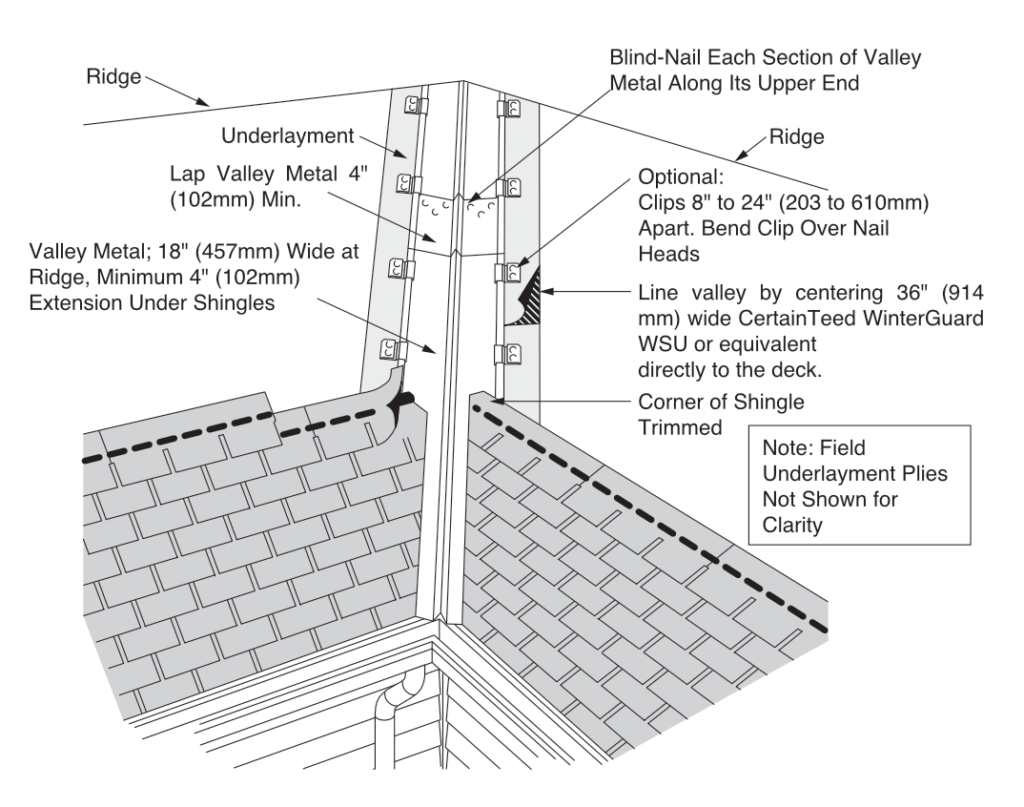
Reference: CertainTeed Shingle Applicator’s Manual; 13th Edition

Filed Under: FYI, Roofing

Asphalt Roof: Woven Valley Applications

March 28, 2019 by Marshal

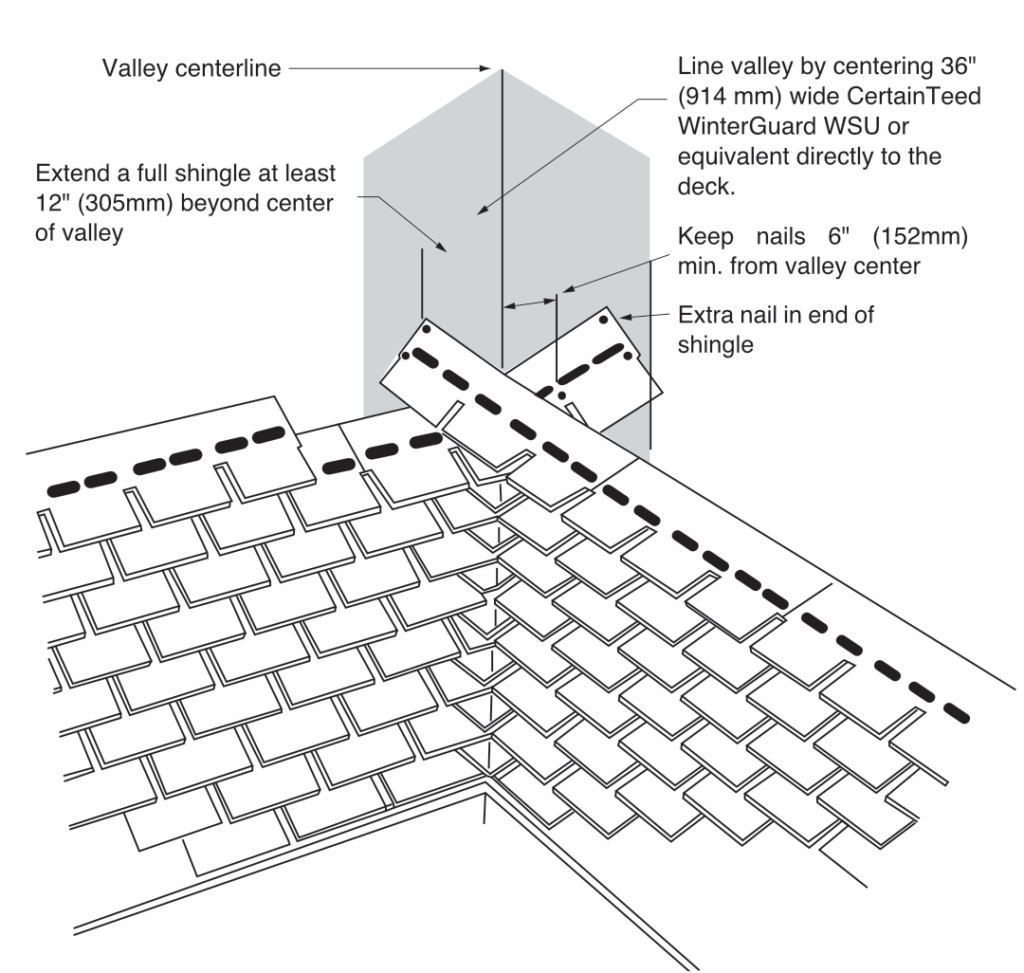
The valley flashing should already be in place. Shingles on the intersecting roof surfaces may be applied toward the valley from both roof areas simultaneously or each roof area may be worked separately up to a point about 3′ from the center of the valley and the gap closed later.

Regardless of which procedure is followed, apply the first course along the eaves of one roof area up to and over the valley with the last shingle extending at least 12″ onto the intersecting roof. Then apply the first course onto the intersecting roof along the eaves and extend it across the valley over the top of the shingles already crossing the valley and at least 12″ onto the other roof surface. Apply successive valley shingles over each other as shown in (Figure 6.19). Press each shingle tightly into the valley and follow the same nailing procedure as the closed valley.

Figure 6.19
Reference: CertainTeed Shingle Applicator’s Manual; 13th Edition

Filed Under: FYI, Roofing

Electrical Panel Grounding and Bonding

March 24, 2019 by Marshal

The topic of grounding and bonding is a never ending area of confusion. The difference between a service panel and a sub panel is also muddy in many minds. Here are the basics on panels and grounding.

NOTE

The explanations here are at a high level. Details have been omitted in the interest of learning just the basics. Home electrical systems are complicated and can be dangerous, we recommend that if you have questions or concerns about the electrical service in your home you contact a licensed electrician.

The Electrical Path

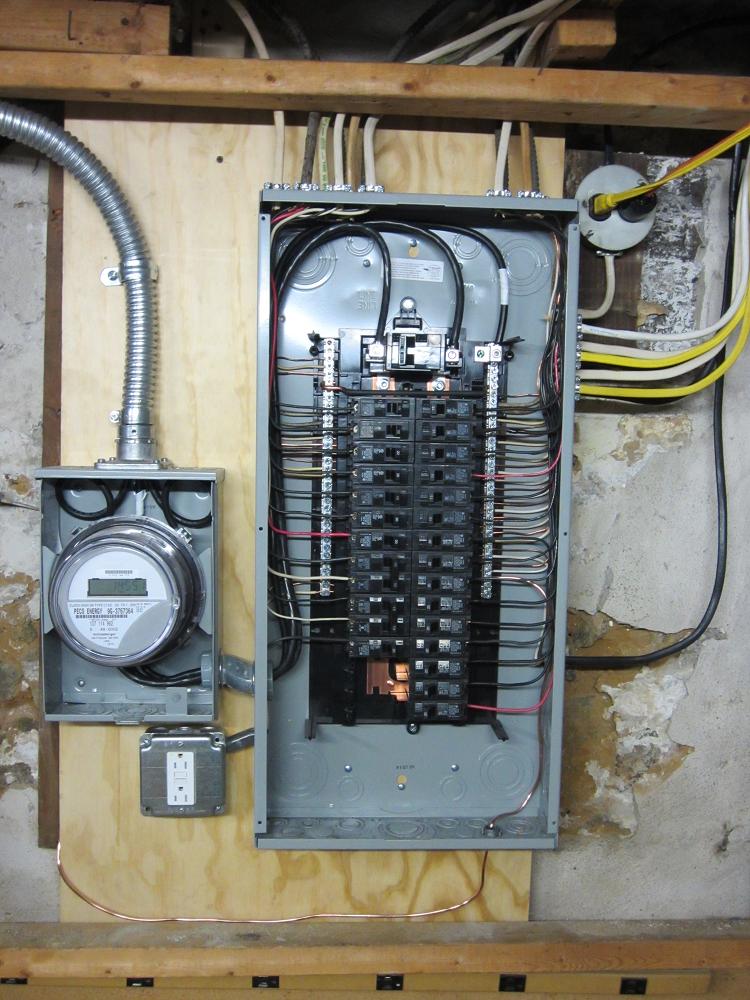
Main Panel
  • The panel that’s located directly after the electric meter is the main service panel.
  • Three wires come from the electric meter and go into the main panel: two live (hot) wires and one neutral.

Main Panels and Sub Panels

There are several different ways main panels are configured in homes, here it is in a nutshell.

  • The main panel has a circuit breaker that controls all the power to your home, this is the Double Pole Service Disconnect, this is also called the “main.”
  • The electricity from the main can be wired in one of two different ways:
    1. It stays within the main panel and goes to the circuit breakers that lead to each branch circuit;
    2. It does to a sub panel which contains circuit breakers that lead to each branch circuit.
  • These two different methods are used for convenience and safety.

Neutral Bonding in Panels

The bonding in panels are done two different ways:

  • Main Panel – the neutral wire is bonded (connected) to the ground wire.
  • Sub Panel – the neutral wire is NOT bonded (connected) to the ground wire.

What’s the difference between bonding and grounding?

These terms are similar, confusing and often used interchangeably. Strictly speaking, a ground wire connects to the ground. Bonding means connecting things electrically together.

  • Ground – a wire that goes to a metal pipe or rod that is embedded several feet into the ground.
  • Bonding – connecting wires together to make one continues connection.

Bonding and Grounding is about Safety

We all are amazed at what electricity can do for us: from powering our air conditioners to keeping us cool in the summer. We should also know that if it is mishandled or its systems are installed incorrectly, becomes obsolete, or wears out, electricity can be very dangerous, in fact it can kill us!

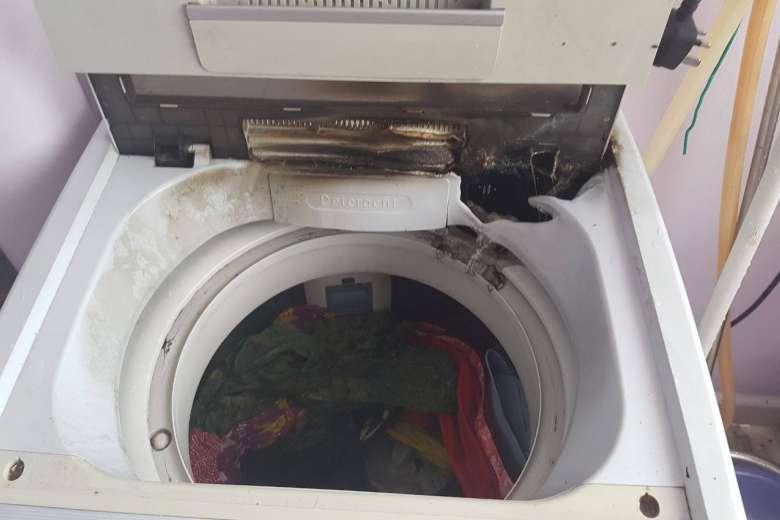
A picture of a defective washing machine that has burn marks on it.
A Defective Washing Machine

Example A wire is rubbing against the metal case of washing machine, after a few years of rubbing the insulation wears away and then touches the metal case energizing it.

If there was no grounding the washing machine would stay energized and the washer may catch fire or the next unlucky person to do the wash will be shocked .

If the washing machine was grounded, the current would flow to the ground, drawing a very high amount of power (a short circuit), which in turn trips the circuit breaker. Voilà, no power to the washing machine and you are safe.

Bonding insures that if there is any stray electricity it will be directed to the ground. If there is a break in the system then any disconnected areas will have the potential of being a shock hazard.

Home Inspection

Home Inspection is all about safety. That’s why when I inspect your electrical system I’ll be looking for anything unusual and bring it to your attention. Inspectors are generalist, not specialists, so if anything looks out of the ordinary I’ll recommend a specialist take a look – a licenced electrician.

Resource Links

  • Electric Panels 101 by Bob Villa
  • What is an Electrical Subpanel?
  • What Is the Ground (Earth) Wire For?
  • Electrical Distribution Panels & Circuit Breaker Fires

Filed Under: Electrical, FYI

The Life Cycle of a Roof

March 23, 2019 by Marshal

A roof is a big investment and we expect it to have a long life. Like all things in this world, roofs do not last forever, they will age, wear out, and then need to be replaced. In this post I will explain the life cycle of a typical asphalt roof that most homeowners in New Jersey have. First how to identify the style of shingle you have.

Three Styles

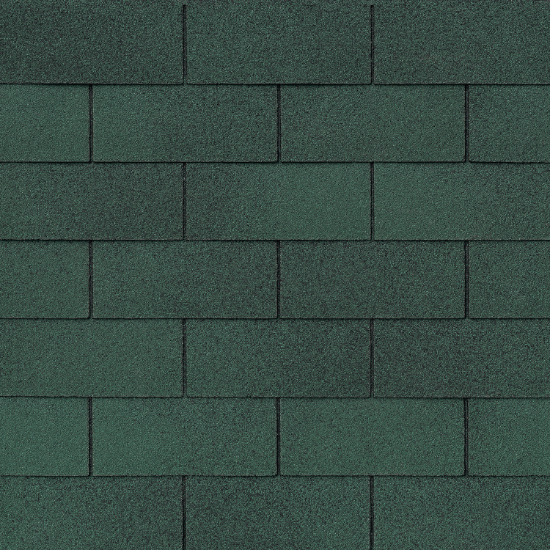
The most basic shingle

Strip Shingle

Manufacturing Defect Warranty:
Depending on weight/manufacturer it can be anywhere from 20 to 30 years

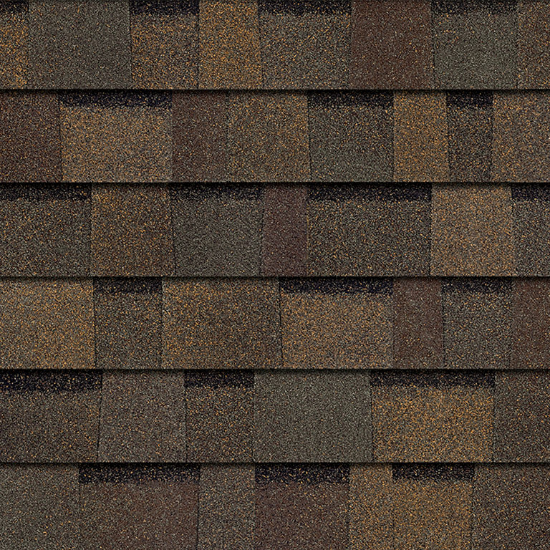
The most popular shingle

Dimensional Shingles

Manufacturing Defect Warranty:
Depending on weight/manufacturer it can be a limited lifetime warranty

A heavyweight premium shingle

Luxury Shingles

The most realistic representation of the old-world wood shake and quarried slate roofing
Manufacturing Defect Warranty:
Depending on weight/manufacturer it can be a limited lifetime warranty

Life Cycle

The moment the roof is installed it begins to age. Normal aging consists of:

  • Heat of the sun
  • Ultraviolet radiation
  • Moisture
  • Pollution
  • Physical damage (walking on it, hail, tree limbs, etc.)
  • Thermal shock

Installation issues:

  • Improper installation
  • Poor ventilation

What’s normal aging?

  • Slight granular lose
  • Curling
  • Algae discoloration

What’s beyond normal aging?

  • Opened blisters
  • Cracking
  • Bald spots – exposed asphalt

End of life

Once the roof shows signs of opened blisters, cracking, bald spots, excessive curling, and other aging issues it will be time to replace the roof. If your roof is leaking does it means it’s time to replace it? Not necessarily, other reasons such as a mechanical or flashing issue can be the culprit. We recommend that if you have a leak or think your roof needs replacement, you consult with a qualified roofing contractor.

Filed Under: FYI, Roofing

Structure

March 15, 2019 by Marshal

When conducting the inspection of the structural components, the home inspector shall:

Inspect Structure

  • Foundation;
  • Floors;
  • Walls;
  • Ceilings; and
  • Roof;
  • Probe structural components where deterioration is suspected unless such probing would damage any finished surface.

Describe Structure

  • Foundation construction type and material;
  • Floor construction type and material;
  • Wall construction type and material;
  • Ceiling construction type and material; and
  • Roof construction type and material;
  • Methods used to inspect under-floor crawl spaces and attics.

Filed Under: SOP Tagged With: Structure

Cooling

March 15, 2019 by Marshal

When inspecting the cooling system, a home inspector shall:

Inspect Cooling System

  • Central cooling system, excluding electronic air filters and excluding determination of cooling supply adequacy or distribution balance and without operating central cooling equipment when weather conditions or other circumstances may cause damage to the cooling equipment;
  • Permanently installed hard-wired, through-wall individual cooling systems;
  • Energy sources;

Describe Cooling System

  • Cooling equipment and distribution type; and
  • Energy sources.

Filed Under: SOP Tagged With: Cooling

Plumbing

March 15, 2019 by Marshal

When inspecting the plumbing system, a home inspector shall:

Inspect Plumbing

  • Interior water supply and distribution systems including functional water flow and functional drainage, excluding wells, well pumps, well water sampling or water storage related equipment, determination of water supply quantity or quality and water conditioning systems and lawn irrigation systems;
  • All interior fixtures and faucets, excluding shut off valves, wells, well pumps, well water sampling and water storage related equipment;
  • Drain, waste and vent systems;
  • Domestic water heating systems, without operating safety valves or automatic safety controls, and excluding solar water heating systems;
  • Combustion vent systems excluding interiors of flues and chimneys;
    Fuel distribution systems; and
  • Drainage sumps, sump pumps and related piping.

Describe Plumbing

  • Predominant interior water supply and distribution piping materials;
  • Predominant drain, waste and vent piping materials; and
  • Water heating equipment including energy sources.

Filed Under: SOP Tagged With: Plumbing

Exterior

March 15, 2019 by Marshal

When inspecting the exterior components, a home inspector shall:

Inspect Exterior

  • Exterior surfaces, excluding shutters, and screening, awnings, and other similar seasonal accessories;
  • Exterior doors excluding storm doors or safety glazing;
  • Windows excluding storm windows and safety glazing;
  • Attached or adjacent decks, balconies, stoops, steps, porches, and their railings;
  • Vegetation, grading, drainage, and retaining walls with respect to their immediate detrimental effect on the condition of the residential building, excluding fences, geological and/or soil conditions, sea walls, break-walls, bulkheads and docks, or erosion control and earth stabilization;
  • Attached or adjacent walkways, patios, and driveways; and
  • Garage doors including automatic door openers and entrapment protection mechanisms, excluding remote control devices.

Describe Exterior

Describe exterior wall surface type and material.

Filed Under: SOP Tagged With: Exterior

Roofing

March 15, 2019 by Marshal

When inspecting the roof of a residential building, the home inspector shall:

Inspect Roofing

  • Roofing surface, excluding antennae and other installed accessories such as solar heating systems, lightning arresters, and satellite dishes;
  • Roof drainage systems; Flashing; Skylights; and
  • Exterior of chimneys.

Describe Roofing

  • Roof surface;
  • Roof drainage systems;
  • Flashing; Skylights; and
  • Chimneys.

Safety

  • Employ reasonable, practicable and safe methods to inspect the roof such as:
    • Walking on the roof;
    • Observation from a ladder at roof level; or
    • Visual examination with binoculars from ground level; and
    • Describe the methods used to inspect the roof.

Filed Under: SOP Tagged With: Roofing

Fireplaces and Solid Fuel Burning Appliances

March 6, 2019 by Marshal

Fireplaces traditionally make a house a home for many people. In the past they were essential to heat our homes and cook our meals, today they are more decorative than essential. There have been innovations to make fireplaces more efficient and wood or pellet burning stoves can be a very efficient way to heat a home.

In your home inspection we are concerned about safety and we will inspect:

  • Fireplaces and solid fuel burning appliances;
  • Chimneys and combustion vents.

Filed Under: Services

  • « Go to Previous Page
  • Page 1
  • Interim pages omitted …
  • Page 7
  • Page 8
  • Page 9
  • Page 10
  • Go to Next Page »

Footer

Optimal Home Inspections LLC

Call 551-261-1264

Optimal Home Inspections
2600 John F Kennedy Blvd
Jersey City, NJ 07306
North Jersey - Hudson County
(551) 261-1264

101 Dunhams Corner Rd
East Brunswick, NJ 08816
Central Jersey - Middlesex County
(551) 261-1264

Follow us

  • facebook
  • instagram
  • linkedin
  • threads
  • x

Licenses

NJ Home Inspector License Number: 24GI00176700

Certified Radon Measurement Technician: MET13906

Termite Inspector – Commercial Pesticide Applicator License Number: 61282B

Lead-Safe Certified Firm NAT-F238931-1

Associations

American Society of Home Inspectors (ASHI)
Garden State Chapter American Society of Home Inspectors
International Association of Certified Home Inspectors (InterNACHI)
NJ International Association of Certified Home Inspectors

Our Service Area

I inspect homes in Bergin, Essex, Hudson, Middlesex, Monmouth, Morris, Passaic, Somerset, and Union Counties. I inspect anywhere in New Jersey, but the counties listed here are where I work most.

Opening Hours

Monday 8 AM – 9 PM
Tuesday 8 AM – 9 PM
Wednesday 8 AM – 9 PM
Thursday 8 AM – 9 PM
Friday 8 AM – 9 PM
Saturday 8 AM – 9 PM
Sunday 8 AM – 9 PM

Copyright © 2026 · Optimal Home Inspections LLC · Log in

  • Home
  • Book an Inspection
  • Services
  • Pricing
  • Standards
  • Resources
  • Reports